
You just closed your fund. Twenty-five investors committed $5M. Now comes the question every first-time fund manager asks: “How often should I actually communicate with these people?”
Too little communication can lead to investors forgetting about you, feeling disconnected, and not reinvesting in your next fund.
Too much communication can annoy them, waste their time, and make you appear needy or disorganized.
In this article, we explore how to effectively communicate with investors.
Key Takeaways
- Quarterly is minimum, monthly is optimal – Investors expect at least quarterly detailed reports; monthly brief updates significantly increase engagement and retention
- Communication frequency directly impacts re-investment rates
- More frequent isn’t always better – Weekly updates annoy investors unless tied to major developments; find the balance between presence and pestering
- Different investor segments need different frequencies – Large investors may want monthly calls; small investors are fine with quarterly emails
- Consistency matters more than perfection – Better to send predictable quarterly reports than erratic monthly updates that arrive randomly
The Baseline: What Investors Expect
Before optimizing frequency, understand the baseline expectations.
Industry Standard: Quarterly Reports
What Investors Expect Minimum:
- Detailed performance report every quarter
- Sent within 15-30 days of quarter-end
- Covers financials, operations, and market updates
- Consistent format and timing
Why Quarterly:
- Matches financial reporting cycles
- Enough time for meaningful developments
- Standard across most funds
- Manageable for fund managers
If You’re Only Doing Quarterly: This meets minimum obligation but doesn’t build strong relationships or maximize retention.
Best Practice: Monthly + Quarterly
What Top Performers Do:
- Monthly: Brief updates
- Quarterly: Detailed performance reports
- Ad-hoc: Major events (acquisitions, exits, problems)
- Annual: Comprehensive year-in-review
Why This Works:
- Stays top-of-mind without overwhelming
- Keeps investors engaged between detailed reports
- Shows activity and progress
- Builds stronger relationships
Bottom Line: Quarterly is acceptable. Monthly plus quarterly is optimal for retention and engagement.
The Optimal Communication Calendar
Here’s the proven framework successful fund managers use.
Monthly Brief Updates
Timing: First week of each month for the previous month
Content:
- 1-2 paragraph executive summary
- Key metrics snapshot (occupancy, rents, NOI)
- 3-5 bullet points of monthly highlights
- 1-2 challenges or developments
- Next month’s outlook
Example Structure:
“October 2025 Update
Portfolio occupancy reached 96.5%, up from 95.2% in September. Rental income increased $42K month-over-month, driven by rent increases at Desert Vista and improved occupancy at Canyon Ridge.
Highlights:
- Completed 18-unit renovations at Phoenix property (ahead of schedule)
- Signed lease for retail space at a premium to projections ($28/sqft vs. $24 projected)
- Reduced property management costs by 8% through vendor renegotiations
Looking Ahead: November focus is completing remaining renovations and preparing for Q4 investor webinar (November 15th – save the date).”
Quarterly Detailed Reports
Timing: Within 15 days of quarter-end (same date each quarter)
Content:
- Executive summary (page 1)
- Portfolio performance vs. projections
- Property-level details and updates
- Financial performance (income statement, distributions)
- Market analysis and trends
- Strategy updates and outlook
- Looking ahead (next quarter priorities)
Annual Comprehensive Review (15-20 Pages)
Timing: Within 60 days of year-end (coordinate with K-1 distribution)
Content:
- Full-year performance vs. projections
- Complete financial statements
- Every property’s detailed review
- Market retrospective and outlook
- Strategy achievements and lessons learned
- Next year’s outlook and priorities
- Tax documents (K-1s)
Ad-Hoc Communications (As Needed)
Major Acquisitions: Within 48 hours of closing, send a brief announcement email with property details, investment thesis, and how it fits the portfolio.
Major Dispositions: Immediately upon sale, announce pricing, returns achieved vs. projected, and lessons learned.
Significant Problems: Promptly when material issues arise (major tenant default, property damage, regulatory issues). Don’t wait for the quarterly report.
Capital Calls: At least 30 days’ notice, clear explanation of use and timing.
Investor Events: Webinars, property tours, annual meetings — announce 30-45 days in advance with reminders.
Annual Calendar Example:
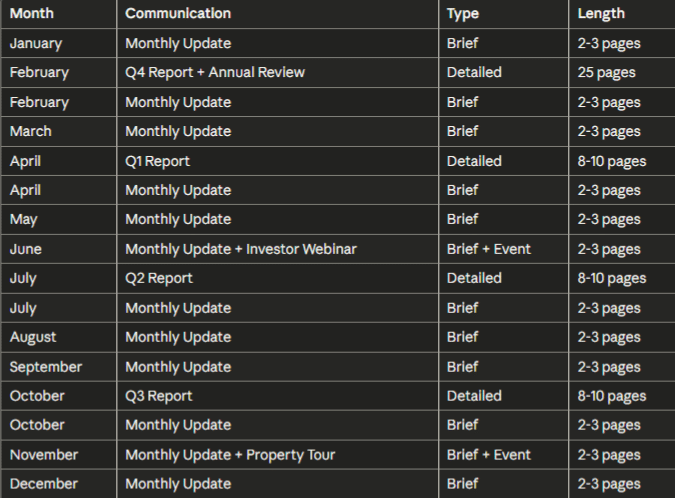
Total: 12 monthly updates + 4 quarterly reports + 1 annual review + 2-3 events = ~20 total communications
Touchpoints per investor: 18-20 per year
Average: 1.5 touchpoints per month
This feels consistent without overwhelming.
Segmenting by Investor Type
Not all investors need identical communication frequency.
Tier 1: Major Investors ($250K+)
Frequency:
- Monthly updates (same as everyone)
- Quarterly reports (same as everyone)
- Plus: Quarterly personal calls or meetings
- Plus: First notification of major developments
- Plus: Input on strategic decisions (if appropriate)
Why Different:
- Larger capital deserves more access
- Build stronger relationships for future funds
- Often sophisticated investors with valuable input
- Most likely to refer other large investors
Time Investment: 30-60 minutes per investor quarterly
Tier 2: Standard Investors ($50K-$250K)
Frequency:
- Monthly updates
- Quarterly reports
- Annual meeting/webinar access
- Responsive to their inquiries
Why Standard:
- Represents the bulk of most funds
- Want information, not necessarily access
- Monthly + quarterly meets needs
Time Investment: Standard communication only
Tier 3: Small Investors (<$50K)
Frequency:
- Same as Tier 2 (monthly + quarterly)
- Some funds reduce to quarterly-only for smallest investors
Consideration: Don’t make investors feel second-class. Better to give everyone baseline monthly + quarterly than create visible tiers.
Time Investment: Standard communication only
Special Segments
Family and Close Friends:
- May want more informal, frequent updates
- Casual emails or texts with developments
- Less formal reporting is acceptable
- Balance relationship with professionalism
Institutional or Professional Investors:
- Often prefer quarterly only (less frequent, more detailed)
- Direct access to data rooms or portals
- Formal communication only
- May have specific reporting requirements in agreements
When More Frequent Communication Makes Sense
In certain situations, increase frequency temporarily.
Development or Value-Add Projects
Situation: Active construction or major renovations
Frequency: Weekly or bi-weekly progress updates during the active phase
Example:
“Week 12 Renovation Update: Completed 8 units this week (total 42 of 64 complete). On track for November 30 completion. Next week: HVAC installation in Building C.”
Why: Investors want to see progress on capital-intensive projects. Regular updates build confidence.
Duration: Only during active project phase (8-16 weeks typically)
Crisis or Problem Management
Situation: Major tenant default, property damage, market disruption
Frequency: Weekly updates until resolved
Example:
“Week 2 Update: Insurance adjuster completed assessment. Claim filed for $280K. Repairs begin next week. Expect a 4-week timeline to completion.”
Why: Frequent updates during problems prevent investor anxiety and show you’re handling issues proactively.
Duration: Until the situation stabilizes
Fund Formation or Capital Raise
Situation: Raising new funds
Frequency: Bi-weekly or monthly updates to prospects and existing investors
Example:
“Fund II Update: $8.5M committed of $15M target. 34 investors committed. Evaluating 3 properties for initial deployment. Next investor webinar: December 15.”
Why: Momentum and social proof drive additional commitments. Regular updates create urgency.
Duration: Throughout the raise period (3-9 months typically)
Major Strategic Shift
Situation: Changing investment strategy, markets, or structure
Frequency: Monthly during transition period
Why: Investors want to understand why and track implementation.
Duration: 3-6 months until a new strategy is established
When Less Frequent Communication Is Acceptable
Some situations justify reducing frequency.
Stabilized, Performing Assets
Situation: Portfolio performing exactly as projected, no significant developments
Consideration: Monthly updates become repetitive
“November was another strong month. Occupancy 96%, same as October. Rents increased $15/unit, matching plan.”
Option: Reduce to quarterly detailed reports only, with ad-hoc updates for actual developments
Risk: Investors may interpret reduced communication as problems or disengagement
Best Practice: Stick with monthly even if brief and repetitive. Consistency builds trust.
Pre-Exit Hold Period
Situation: Properties fully stabilized, holding for market timing or loan maturity
Consideration: Little changes month-to-month in the final 12-18 months of hold
Option: Quarterly reports are sufficient
Communication:
“Portfolio fully stabilized and performing as projected. Preparing for exit in Q4 2026. Quarterly reports will continue through the hold period.”
Fund Fully Exited
Situation: All properties sold, capital returned to investors
Frequency: Final report, then annual updates if planning future funds
Content:
- Final performance summary
- Total returns vs. projected
- Lessons learned
- Timeline for next fund (if applicable)
The Too Much Problem: Warning Signs
You can over-communicate. Watch for these signals.
Warning Signs
Email Open Rates Declining:
- Started at 75%, now 45%
- Investors are tuning out due to frequency fatigue
Unsubscribe Requests:
- “Too many emails”
- “Only send quarterly reports”
- More than 5% requesting reduced frequency
Survey Feedback:
- “Communication is too frequent”
- “Emails don’t contain meaningful updates”
- Lower satisfaction scores on communication
Declining Response Rates:
- Used to get replies, now silence
- Event attendance dropping
- Portal logins decreasing
Solutions
Reduce Frequency:
- Cut back from weekly to monthly
- Combine multiple small updates into one larger update
Increase Value Per Communication:
- Ensure each email has meaningful content
- Skip update if nothing new to report
- Quality over quantity
Segment Preferences:
- Survey investors on preferred frequency
- Create “brief updates” vs. “detailed only” lists
- Let investors choose cadence
Improve Content:
- Make emails more scannable (bullets, headers)
- Lead with the most important information
- Keep length appropriate (monthly = brief, quarterly = detailed)
Implementation: Getting Started
If you’re not communicating monthly, here’s how to start.
Month 1: Setup
Week 1: Create Template
- Monthly update format (2-3 pages)
- Quarterly report template (8-10 pages)
- Decide which metrics to track
- Set up calendar reminders
Week 2: Communication Plan
- Document schedule (which day each month)
- Assign responsibilities (who creates content)
- Set up distribution system (email platform)
- Create an investor communication preferences survey
Week 3: Send Survey
- Ask investors’ preferred frequency
- Content preferences (more financial vs. operational)
- Format preferences (PDF vs. email vs. portal)
- Timing preferences (beginning vs. end of month)
Week 4: Finalize Plan
- Adjust based on survey results
- Communicate plan to investors: “Starting next month, you’ll receive brief monthly updates plus detailed quarterly reports.”
- Build first month’s update
Month 2: Launch
Send your first monthly brief update. Include note: “We’re increasing communication frequency to monthly brief updates (like this one) plus detailed quarterly reports. This helps us keep you informed while respecting your time. Feedback welcome.”
Track:
- Open rates
- Click rates
- Responses
- Any requests to reduce frequency
Month 3-4: Refine
Based on engagement:
- Adjust length if needed (too long/short)
- Improve format (more scannable)
- Test different send times
- Refine content based on questions received
Month 5+: Maintain Consistency
Stick to the schedule.
Time Investment:
- Monthly updates: 30-45 minutes each
- Quarterly reports: 4-6 hours each
- Total: 12-15 hours per quarter (~1 hour per week)
This is manageable for any fund manager and pays dividends in retention.
Finding the Right Communication Frequency
Most fund managers communicate too little, not too much. Quarterly-only communication meets minimum obligation but doesn’t build the relationships that drive re-investment and referrals.
The optimal frequency for most funds: Monthly brief updates (2-3 pages) + quarterly detailed reports (8-10 pages) + ad-hoc announcements for major events.
This provides ~18-20 touchpoints annually — enough to stay top-of-mind without overwhelming. Investors remain engaged, informed, and confident in your management.
Start with monthly updates. Track engagement metrics. Adjust based on investor feedback. But don’t use uncertainty as an excuse to under-communicate. When in doubt, communicate more, not less.
The fund managers who successfully raise Fund III, IV, and V all share one trait: their investors feel connected, informed, and confident because of consistent, quality communication. Build that foundation now, starting with your next monthly update.
Lightmark has worked with real estate entrepreneurs to raise private equity since 2012. Today, we help some of the most respected private equity firms in the US raise capital for real estate, energy, and other sectors.
Click the “Get Started” button below to learn more about the software, systems, and strategies that we use every day to raise capital for real estate fund managers, syndicators, and capital aggregators.